
Faculty & Publications
The MA in Education is a flagship programme of the university. Hence, the teaching faculty come with rich disciplinary knowledge, research and practice experience in their respective fields. The eclectic faculty group comprises Mathematicians, Scientists, Linguists, Philosophers, Social Scientists and Psychologists.
News
-
AI from Class III: Is India’s emphasis on technology in primary education a leap forward or one too soon?
AI is both seductive and addictive. We need to exercise social wisdom in taking decisions about placing it in the hands of small children, writes R Ramanujam in The Indian Express.
-
How to build an enabling school culture
Every member of the school community — students, educators, parents, and support staff — must feel equally valued, respected, and believe that they have a voice and representation in matters that affect them, writes Ankur Madan in The Hindu.
-
Education accountability: Dump classroom cameras and trust teachers
Intrusive surveillance will hurt an endeavour that thrives on professional ethics and human bonds, writes Anurag Behar in Mint.
-
From scores to stories: The report card parents and students have long awaited!
With the shift toward competency-based assessment, report cards are being reimagined as rich tools for learning and growth, writes Pooja Arya in Economic Times Education.
-
Letting AI think for us will destroy the purpose of education
The process of wrestling with ideas, anticipating challenges and adapting — that’s where most real learning happens. Like pre-made lesson plans, AI can be a tool, but it must never impinge on the core of education, writes Anurag Behar in Mint.
-
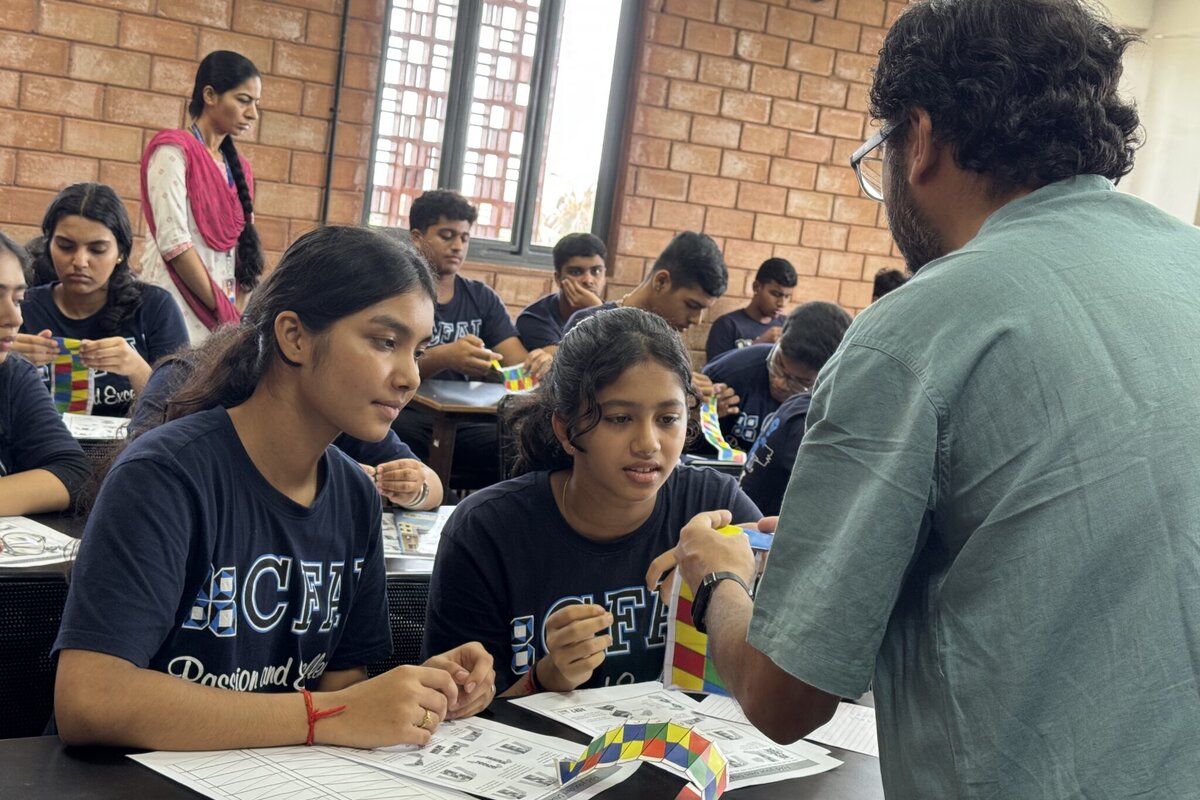

Back to High School: An Outreach Effort by Scientists
Entertaining close to 350 high school students with science sounds like a tall task, but a group of faculty members from Azim Premji University rose to the challenge, writes Nandita Jayaraj.
-
Building a case for my freedom in rural Rajasthan
Pooja Kumari highlights in India Development Review (IDR) how she built trust slowly, not by arguing, but by showing people around her what she was capable of.
-
How to Equip Teachers for Classroom Diversity and Inclusion
Teachers must be supported with adequate skills and knowledge to cope with the heterogeneity of modern classrooms if we are to create a truly inclusive society, writes Ankur Madan, in The Hindu.
-
Inclusive Preschools Benefit All Children
It helps children with specific challenges to expand their skills through observation and participation. Their peers develop acceptance and an appreciation for individual differences from an early age, write Sofiya S and Bhuvaneswari B, in The Hans India.
-
Supporting Neurodiverse Learners in Universities
Neurodivergent students are capable of visual thinking, pattern organisation and creative thinking, and they should not be defined as intellectually disabled, write Bhuvaneswari B and Sharoon Sunny, in Education Times.
- Bardapurkar, A. (2022). What is Good? A Study of Educational Insights in Nicomachean Ethics (Book I, II and III). Journal of Human Values, 28(1), 11 – 19. https://doi.org/10.1177/09716858211058778
- Rajan, V. (2023). Migrant childhoods and temporalities in India: A reflective engagement with dominant discourses. Journal of Childhood Studies, 48(1), 30 – 43. https://doi.org/10.18357/jcs202320499
- Mathai, S. (2021). The good, the popular and the bad: different shades of ‘theory’ use in educational research. Contemporary Education Dialogue, 18(2), 250 – 258. CED.
Srinivasan, R (2021). Listening to the voices of teachers through Dewey’s ideas. In JuliAnna Ávila, AG Rud, Leonard Waks and Emer Ring (Eds). The Contemporary Relevance of John Dewey’s Theories on Teaching and Learning: Deweyan Perspectives on Standardization, Accountability, and Assessment in Education. Routledge International Studies in the Philosophy of Education.